
Viral Clearance in Bioprocessing
What Is Viral Clearance?
Post chromatography, the product has reached high purity and is largely free of process-related impurities. Viral clearance is a critical downstream bioprocessing step that removes or inactivates viruses to ensure product safety and regulatory compliance. While chromatography achieves high product purity, regulatory agencies require dedicated viral clearance processes to protect patients and support product licensure.
Common methods include:
- Low-pH viral inactivation
- Detergent treatment
- Virus-retentive nanofiltration
Failure to achieve effective viral clearance can result in batch rejection, regulatory concerns, and production interruptions.
- Regulatory Requirements
- Key Process Parameters and Challenges
- Benefits of In-Line Monitoring
- Summary Table
Viral clearance processes must comply with:
- ICH Q5A(R2)
- FDA Viral Safety Guidance
- EMA Viral Safety Guidelines
- USP <1237>
Compliance is demonstrated by maintaining validated process parameters within approved ranges, documenting consistent viral inactivation and removal performance across batches. In-line pH, temperature, pressure, flow, and UV absorbance monitoring provide real-time confirmation that helps verify that critical process parameters remain within approved ranges while generating traceable, compliance-ready records.
pH
Confirms validated low-pH viral inactivation conditions.
Temperature
Maintains inactivation of kinetics and filtration performance.
Pressure and Flow
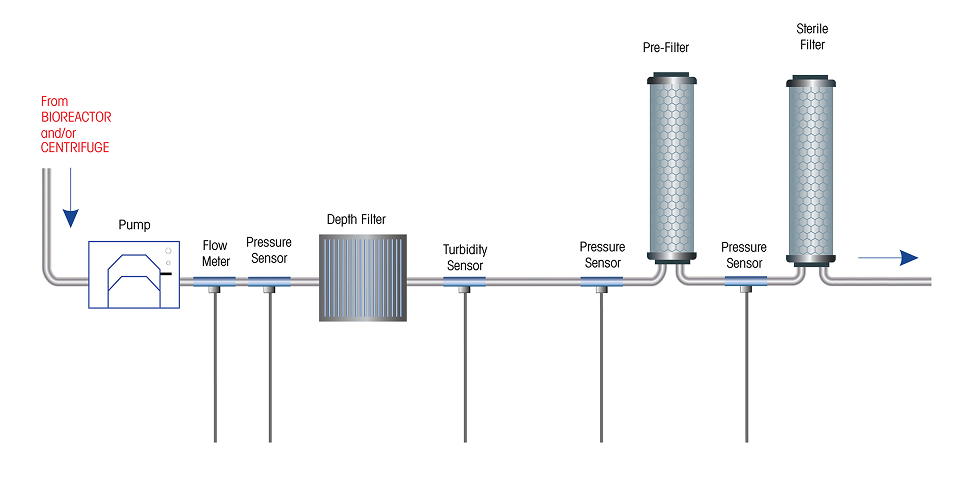
Detect filter fouling, blockage, and throughput issues during virus filtration.
UV Absorbance
Monitors product breakthrough during nanofiltration and process performance.
Common Viral Clearance Challenges
- Protein aggregation caused by prolonged low-pH exposure
- Residual detergent impacting product stability
- Virus filter fouling that reduces throughput and may compromise filtration efficiency
These risks highlight the need for continuous process monitoring and control.
Real-time monitoring using in-line sensors for pH, temperature, pressure, flow, and UV absorbance enables proactive management of viral clearance operations by:
- Detecting deviations early
- Improving process reproducibility
- Reducing the risk of viral clearance failures
- Supporting process optimization
- Generating compliance-ready electronic records
Key metrics such as log reduction value (LRV), filter throughput, and pressure trends support process optimization and long-term process reliability.
These metrics confirm viral clearance performance across campaigns and provide input to generate compliance-ready electronic records that fulfill regulatory expectations for validated, robust viral safety processes.
| Critical Parameter | Why It Matters | Monitoring Technology | Best Practice / Mitigation |
|---|---|---|---|
| pH | Confirms validated low pH hold for inactivation | In-line pH sensor | Strictly control pH during low-pH hold: limit exposure time to prevent aggregation. |
| Temperature | Maintains inactivation kinetics/filtration efficiency | In-line temperature sensor | Maintain a validated temperature range by continuous monitoring. |
| Pressure and Flow | Reveals fouling/blockage in nanofilters | In-line pressure and flow sensors | Track pressure and flow rates: backflush or replace filters before fouling limits. |
| UV Absorbance | Detects breakthrough during filtration | In-line UV detector | Monitor UV absorbance to detect breakthrough: change filter if detected. |
Discover how Mettler-Toledo Pendotech Monitoring Technologies Supports Viral Clearance and Ensure Compliance with Viral Safety Regulations.
Mettler-Toledo Pendotech monitoring technologies provide real-time measurement of critical parameters, including:
Continuous process visibility helps manufacturers strengthen viral safety, improve process control, and maintain compliance with global regulatory requirements.
What Comes Next?
Once the viral clearance is completed, the product is both highly purified and safeguarded. The next downstream processing step is Ultrafiltration/Diafiltration (UF/DF), where the biologic is concentrated and exchanged into a formulation-compatible buffer, preparing it for final drug substance production.

 © Copyright 2026 Mettler-Toledo Pendotech