
Fill/Finish in Biopharmaceutical Manufacturing
What Is Fill/Finish in Biopharma?
Fill/finish is the final stage of biopharmaceutical manufacturing where sterile drug products are aseptically filled into primary containers, such as vials, syringes, and cartridges. This process is critical for maintaining sterility, ensuring accurate dosing, supporting product stability, and meeting regulatory compliance requirements.
During fill/finish operations, formulated drug substances are transferred from an API vessel through sterile processing components, including pumps, flow meters, pressure sensors, UV cells, conductivity sensors, temperature sensors, and sterile filters, before entering the final container closure system.
Accurate monitoring and control during aseptic filling help reduce variability, minimize contamination risk, and support consistent product quality in commercial biopharmaceutical manufacturing.
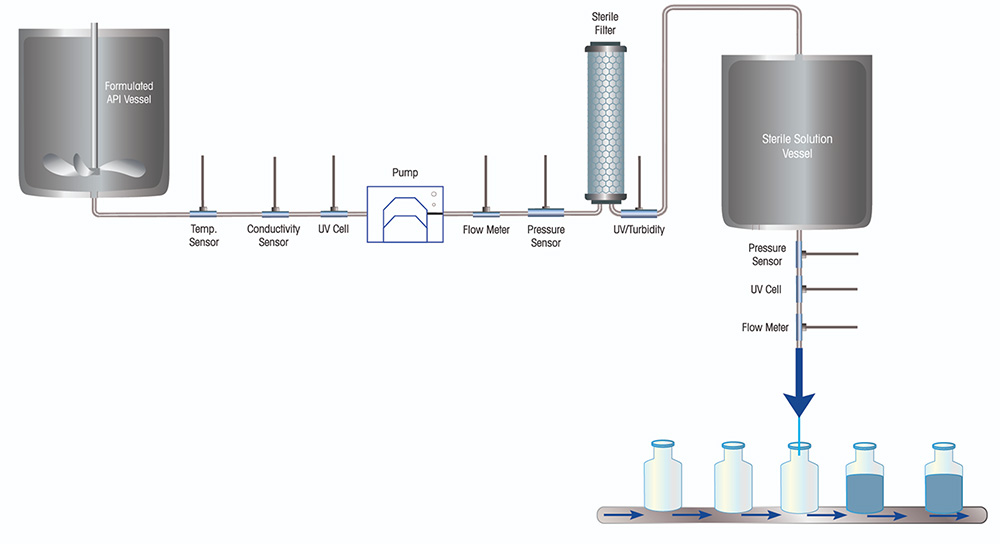
Fill/finish operations directly impact:
- Drug product sterility
- Fill accuracy and dosing consistency
- Product stability and shelf life
- Batch release efficiency
- Regulatory compliance
- Patient safety
Any deviation in fill volume, sterile filtration, temperature control, or aseptic handling can affect drug product efficacy, stability, and compliance with FDA and global GMP expectations.
Following filling, sterile solutions must be maintained under validated storage and cold chain conditions to preserve potency and maintain container-closure integrity during distribution and administration.
Modern fill/finish systems rely on integrated process monitoring technologies to improve process visibility, support validation, and reduce operational risk.
These technologies support real-time monitoring of fluid transfer, sterile filtration performance, process pressure, conductivity, UV absorbance, and temperature conditions throughout aseptic filling operations.
- Regulatory Requirements
- Key Process Parameters and Challenges
- In-Line/On-Line Monitoring
- Summary Table
Biopharmaceutical fill/finish operations must comply with:
- FDA 21 CFR 211.42
- FDA 21 CFR 211.94
- FDA 21 CFR 211.165
- USP <659>
- ICH Q1A(R2)
- ICH Q8–Q10
- FDA Process Validation Guidance
- EU GMP Annex 1 and Annex 2
These regulations establish expectations for:
- Aseptic processing
- Fill accuracy
- Container-closure integrity
- Environmental monitoring
- Process validation
- Temperature-controlled storage
- Batch traceability and documentation
Continuous monitoring of pressure, flow, temperature, and fill performance helps manufacturers maintain validated operating conditions and support regulatory readiness.
Weight and Volume Control
Accurate fill weight and fill volume verification help ensure each container meets labeled dosing requirements and product specifications.
Common Challenges
- Overfilling or underfilling
- Batch variability
- Dosing inconsistencies
- Regulatory non-compliance
Temperature Monitoring
Temperature control is essential for maintaining sterile drug product stability during filling, storage, and distribution.
Common Challenges
- Temperature excursions
- Reduced potency
- Shortened shelf life
- Cold chain deviations
Sterility and Container Integrity
Sterile filters, aseptic handling procedures, and validated closure systems help protect sterile drug products from contamination.
Common Challenges
- Closure seal failures
- Sterility breaches
- Increased contamination risk
- Product rejection or recalls
Although direct in-line weight and volume sensors are not commonly used in aseptic filling systems, pressure sensors can support indirect fill monitoring through pressure-to-volume correlation models based on fluid levels and container geometry.
In-line and on-line monitoring technologies help manufacturers:
- Improve process visibility
- Detect fill deviations in real time
- Support process validation
- Reduce manual inspection requirements
- Improve batch consistency
- Maintain regulatory compliance
Key process metrics may include:
- Fill accuracy
- Pressure trends
- Flow consistency
- Temperature compliance
- Deviation rates
- Storage condition verification
These data-driven monitoring approaches support faster batch release, improved process control, and enhanced patient safety in pharmaceutical and biopharmaceutical fill/finish manufacturing operations.
| Critical Parameter | Why It Matters | Monitoring Technology | Best Practice / Mitigation |
|---|---|---|---|
| Pressure-Based Volume Estimation | Enables inferred volume tracking without intrusive sensors | In-line pressure sensor | Calibrate pressure-to-volume correlation for each container type |
| Temperature | Maintains product stability in storage | Continuous temperature data logger | Maintain validated cold chain: monitor temperature continuously. |
| Conductivity | Verifying that impurities are minimized and the process is consistent | In-line conductivity sensor | Ensure the correct composition and quality of buffers and solutions |
| Volumetric Flow Rate (Transfer) |
Ensures precise fluid transfer through the sterile filter, minimizing variability and product loss. | Single-use flow meter (Post-Pump) |
Utilize high-accuracy single-use rotary or non-invasive ultrasonic flow meters for precise, scalable fluid transfer without compromising the sterile envelope. |
| Sterile Filter Integrity & Breakthrough Detection | Provides immediate, real-time alerting if the sterile membrane fails, preventing contamination of the downstream bulk sterile vessel. | Single-use UV/Turbidity flow cell & photometer (Post-Sterile Filter) |
Utilize dual-wavelength photometry: monitor UV at 280 nm for protein transmission and turbidity at 880 nm to instantly detect debris indicating a filter breach. |
| Protein Concentration (Final Check) |
Acts as the ultimate safeguard to detect protein aggregation, settling, or loss to the sterile filter right before filling. | Single-use UV flow cell & photometer (Pre-Fill Header) |
Monitor absorbance at standard active wavelengths (e.g., 280 nm and 300 nm) |
| Volumetric Flow Rate (Final Dosing) |
Provides 100% real-time volumetric verification of the dose delivered to each vial. | Single-use low-flow meter (Final Fill Manifold) |
Implement low-flow rotary or ultrasonic sensors at the filling heads to provide high-resolution dosing verification and reduce reliance on statistical check-weighing. |
Explore how Pendotech’s in-line pressure sensors and temperature monitoring technologies support dosing accuracy and storage compliance, enabling robust, traceable control throughout your fill/finish workflow.
With fill/finish and storage complete, the biologic has passed through every critical workflow in DSP: from cell culture to patient-ready drug product. In-line monitoring at each stage delivers compliance, consistency, and safety.

 © Copyright 2026 Mettler-Toledo Pendotech